
Solarsat guide
Cat6 vs Cat6a Network Cabling: Which Should You Fit?
Choosing between Cat6 and Cat6a is not simply a question of buying the highest category available. Both are structured copper cabling options, but their performance specifications, cable dimensions, termination demands and cost implications differ. The right choice depends on distance, network equipment, installation environment and how long the cabling is expected to remain useful.
Phones and email Monday to Saturday, 8:30am to 6pm. Showroom visits by appointment.
What the category labels describe
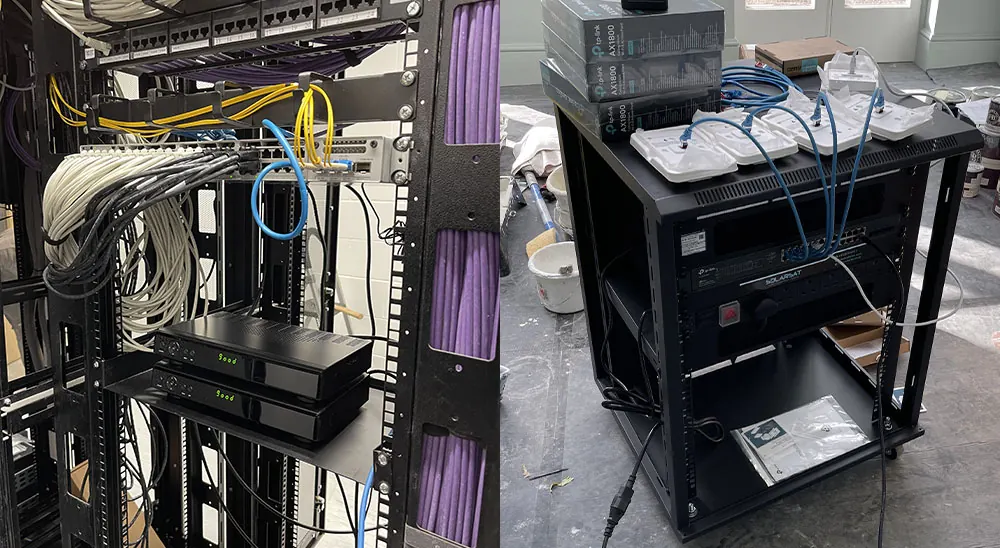
Cat6 and Cat6a are performance categories for balanced twisted-pair cabling and associated components. A compliant channel depends on the complete link, including cable, outlets, patch leads and workmanship. Fitting one higher-category cable does not make the entire connection meet that category if the jacks or patching are lower specification.
Cat6 supports 1 Gigabit Ethernet to the standard channel length of 100 metres. It can also support 10 Gigabit Ethernet over shorter distances, commonly up to 55 metres under suitable conditions. Cat6a is specified for 10 Gigabit Ethernet to 100 metres when the complete channel is correctly installed and tested.
These figures are not a guarantee that every network will deliver a particular internet speed. The switches, network cards, configuration and service also set limits. Cabling provides a stable physical pathway and headroom, rather than increasing the broadband package by itself.
When Cat6 is a sensible fit
Cat6 is often appropriate for domestic networks and smaller office links where Gigabit connections meet the expected need. It can support access points, computers, televisions and many network cameras. For a route that is straightforward and equipment plans are modest, it may provide a practical balance between capability and ease of installation.
Check the longest permanent link and anticipated use before selecting it. A short run in a home is not the same as a full-length channel through a large building. If higher-speed switching or server connections are part of the near-term plan, verify the specific Cat6 limits and channel design rather than relying on general claims.
Quality and installation remain important. Avoid tight bends, crushing, over-stapling and excessive untwisting at terminations. A poorly fitted Cat6 link can perform worse than a correctly installed lower category. Testing and labelling are valuable whichever cable type is chosen.
Reasons to specify Cat6a
Cat6a is designed to support 10 Gigabit Ethernet across a full 100 metre channel. That can matter for backbone links, demanding work areas, high-capacity access points or buildings where cabling is difficult to replace. It also offers stronger alien crosstalk performance when specified and installed as a complete system.
The trade-off is that Cat6a cable is often thicker and less flexible. This can make conduit fill, bend radius, containment and termination more demanding, particularly in confined cabinets or retrofit routes. Check the cable dimensions and connector compatibility before assuming an existing route can accept it easily.
Avoid buying Cat6a solely as a future-proofing slogan. Decide which network devices might use the extra capability, how long the run is and what the likely upgrade cycle looks like. If the equipment will remain Gigabit for the foreseeable future, a well-designed Cat6 installation may be the more proportionate choice.
Installation environment and compliance
Electrical separation, route length, heat, grouping and proximity to interference all affect design. Data cable should be routed in line with applicable standards and manufacturer guidance, with suitable separation from mains services. Fire performance requirements can vary by building and route, so specify the correct cable type for the location rather than selecting on category alone.
Shielded cable is not automatically superior. It requires compatible connectors and correct bonding practices to work as intended; an incomplete shield system can introduce problems. Unshielded cable is widely used and can perform well when correctly routed. Ask the installer to explain any shielding requirement for the actual environment.
Do not treat the cable jacket as a structural support or use it to bridge sharp edges. Maintain bend radius and pulling tension, and avoid kinks. In a busy building, plan containment, fire stopping and access to outlets before installation so future additions do not damage the data links.
Testing and making the decision
A certification test checks the installed link against the selected category limits, rather than merely showing that a laptop connects. Keep test results with cable labels and a simple route schedule. This makes faults easier to isolate and gives future network work a reliable record of what is installed.
For a new build or major refurbishment, compare the cost of cable, containment, terminations and labour as a complete installation. The premium for Cat6a may be more worthwhile where re-cabling later would disrupt finished walls or business operations. Conversely, tight existing routes can make Cat6 a cleaner and more reliable installation.
Ask for a recommendation tied to the application, not just a category number. Provide the planned switch speeds, link lengths, access point requirements and likely growth. An installer can check the route and components together, explain the trade-offs and leave a tested, clearly identified network.
Have a question about your own property? Contact our Mildenhall team.
Related services
Services this guide covers
Data and network cabling
Wired network sockets, data cabinets and structured cabling for offices and homes, planned for growth and easy to maintain.
Find out moreWi-Fi and networking
Whole-property Wi-Fi, outdoor coverage, wired network points, data cabinets and wireless links between buildings.
Find out more
FAQs
Frequently asked questions
Want advice for your own home or business?
Call our Mildenhall team or send an enquiry and we will talk through the options.
Enquiries
Ask us a question or get a quote
Tell us a little about your property and what you need. We will get back to you to talk it through.
- 01638 515551
- info@solarsat.co.uk
- Phones and email Monday to Saturday, 8:30am to 6pm
- 8 High Street, Mildenhall, Suffolk IP28 7EQ. Showroom visits by appointment.