
Solarsat guide
Data Cabinets and Patch Panels for Homes and Offices
A data cabinet brings network equipment and cabling together in one organised location. A patch panel provides fixed terminations for the cables running to rooms and devices, while short patch leads connect those ports to a switch. Correct sizing, ventilation, labelling and access make the installation easier to maintain than a bundle of loose cables.
Phones and email Monday to Saturday, 8:30am to 6pm. Showroom visits by appointment.
What a cabinet does
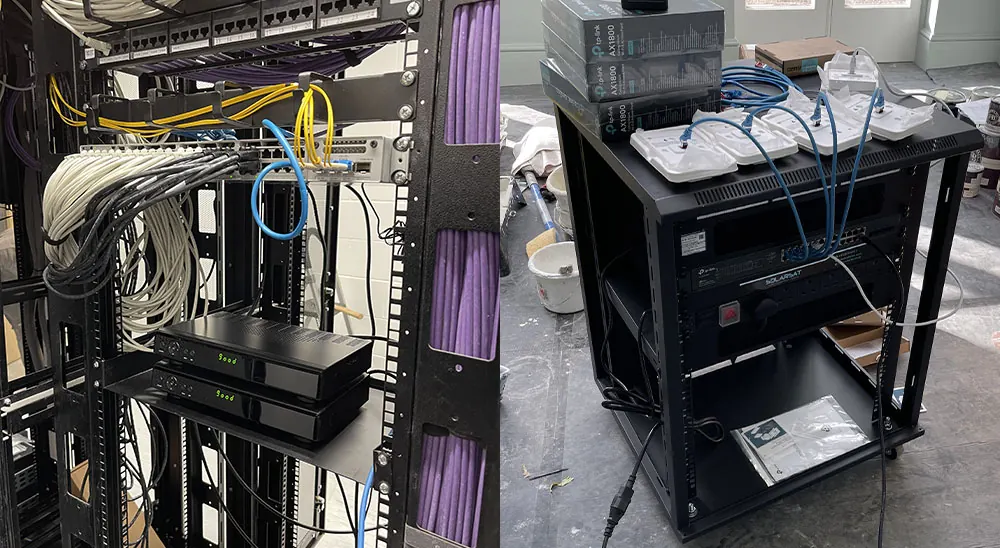
A cabinet or rack provides a defined place for a router, switches, patch panels and sometimes a recorder, server or power equipment. Wall-mounted cabinets suit modest installations, while floor-standing racks provide more capacity. Cabinet choice should reflect the equipment, cable entry, available space and servicing needs, not just the number of network outlets.
A cabinet is not necessarily the broadband modem or router. The service may enter elsewhere, with a data feed linking it to the central network. Map how the incoming connection reaches the router, how the router connects to switches and where patch-panel cables terminate. This simple signal path prevents confusion during setup or troubleshooting.
Consider the room environment. A cupboard can look tidy but become hot, dusty or inaccessible. Keep the cabinet away from water, heat sources and routine impact, and ensure the door can open fully. Equipment should be reachable without moving stored items or dismantling other services.
How a patch panel works
The fixed cables from room outlets terminate at the rear of the patch panel. The front presents numbered ports, which are connected by short patch leads to switch ports. If a room connection needs to move to a different switch or network, the patch lead can be changed without disturbing the permanent cable termination.
A patch panel is passive and does not provide internet, switching or power. It is an organised termination point. The switch manages network traffic, while the router connects networks and usually provides internet routing. Knowing these distinct jobs helps when selecting equipment and diagnosing a failed connection.
Use a panel with compatible modules and a termination method suitable for the cable. Keep the twist in each pair as close to the contact as the manufacturer specifies. Poor termination can limit performance even when the cable category is appropriate, so workmanship and testing matter as much as product labels.
Sizing and choosing equipment
Count installed cables and allow capacity for likely additions. A panel filled to its last port leaves little room for a new access point or printer. Cabinet capacity is often measured in rack units, but usable depth, cable bend space and accessory positions matter too. Check the dimensions of switches, power supplies and any recorder before ordering.
Decide whether a small wall cabinet, open rack or larger enclosed cabinet suits the site. Enclosures can protect equipment and control access, but need ventilation and enough depth for connectors and cable loops. Open racks are easier to access and cool, but offer less physical protection and may not suit a public area.
Plan power sockets and cable entry before fixing the cabinet. Leave room for patch leads to curve without strain, and avoid blocking fans with coils of spare cable. A cabinet that is technically large enough can still be difficult to work in if the front, sides or rear cannot be accessed.
Ventilation, power and security
Switches and recorders generate heat, particularly when installed close together. Follow manufacturer clearance requirements and provide airflow through the cabinet. Do not assume a ventilated door will solve a hot cupboard with no way for warm air to escape. Temperature monitoring can help identify a developing problem in a heavily used installation.
Power should be arranged safely and with enough capacity for connected equipment. Avoid casual chains of extension leads inside a cabinet. If an uninterruptible power supply is appropriate, size it for the actual load and decide which devices need to remain operating during an outage. Fixed electrical work should be undertaken by a suitably competent person.
Restrict access to network equipment, as unplugging a patch lead can disconnect a room and access to a router may expose settings. Keep ventilation unobstructed while securing the cabinet. Record any keys, management details and recovery information in a secure place rather than attaching passwords to the door.
Labelling, testing and ongoing care
Label both ends of each permanent cable with a consistent identifier. The cabinet label should match the room outlet and a simple schedule, for example an outlet code and room description. Avoid names that become misleading after an office rearrangement. Clear identifiers save time when a connection must be moved or tested.
Test each installed link and keep the results with the schedule. A basic continuity check can catch an open pair or miswire, while certification testing verifies performance to the chosen category. Confirm that all ports are mapped correctly before patching equipment, and document which switch port serves important devices.
Keep a small amount of space for future work and inspect cables if equipment is changed. Remove obsolete patch leads instead of leaving a nest that obstructs airflow or hides faults. A tidy cabinet is not just cosmetic: it makes faults visible, reduces accidental disconnections and helps another technician understand the network.
Have a question about your own property? Contact our Mildenhall team.
Related services
Services this guide covers
Data and network cabling
Wired network sockets, data cabinets and structured cabling for offices and homes, planned for growth and easy to maintain.
Find out moreWi-Fi and networking
Whole-property Wi-Fi, outdoor coverage, wired network points, data cabinets and wireless links between buildings.
Find out more
FAQs
Frequently asked questions
Want advice for your own home or business?
Call our Mildenhall team or send an enquiry and we will talk through the options.
Enquiries
Ask us a question or get a quote
Tell us a little about your property and what you need. We will get back to you to talk it through.
- 01638 515551
- info@solarsat.co.uk
- Phones and email Monday to Saturday, 8:30am to 6pm
- 8 High Street, Mildenhall, Suffolk IP28 7EQ. Showroom visits by appointment.