
Solarsat guide
Choose HDMI cabling for the signal you actually need
A picture labelled 4K can place very different demands on a cable depending on refresh rate, HDR and other settings. Reliable video comes from matching the complete signal path, not buying the most impressive label. Plan the required formats, route and replacement access before concealing a cable or selecting an extender.
Phones and email Monday to Saturday, 8:30am to 6pm. Showroom visits by appointment.
Translate picture requirements into cable requirements
Start with the source and display. Record the resolution, refresh rate and HDR formats you want to use, including gaming features where relevant. Higher refresh rates, greater colour depth and different colour sampling settings can change the data requirement substantially. Two systems showing a 4K picture may therefore need different capabilities.
HDMI version numbers describe specifications and are not a reliable shorthand for everything a particular device supports. Features can vary between products and between sockets on one television. Check the source output, any receiver or switch, and the selected display input. An advanced cable cannot add a feature that one of those devices lacks.
For cables, look for the appropriate official cable category and verifiable certification where provided. Premium High Speed and Ultra High Speed certification programmes address different performance requirements. Check the certification label through the relevant verification method rather than relying on an unsupported version-number claim. Choose for your required signal and devices, not a promise of better colours from an otherwise working digital cable.
Choose passive or active cabling for the route
Passive copper HDMI leads need no powered electronics within the cable. Their usable performance depends on construction, length and the signal being carried. There is no single distance at which every passive lead stops working. A cable that handles a basic picture may fail when a higher-bandwidth output mode is selected.
Active cables use electronics to support the connection. Active optical HDMI can be useful on routes where suitable passive copper is impractical, but it must match the required features. Many active optical cables are directional, with source and display ends clearly marked. Install them the right way round and follow bend radius and pulling instructions.
Check whether the active cable supports the required return audio and control functions, and whether additional power is needed. Do not assume optical transport means every signal travels optically or that electrical isolation is guaranteed. Avoid crushing connectors or pulling on them directly. A successful loose test does not protect a cable from damage during installation.
Understand video extenders and data cable
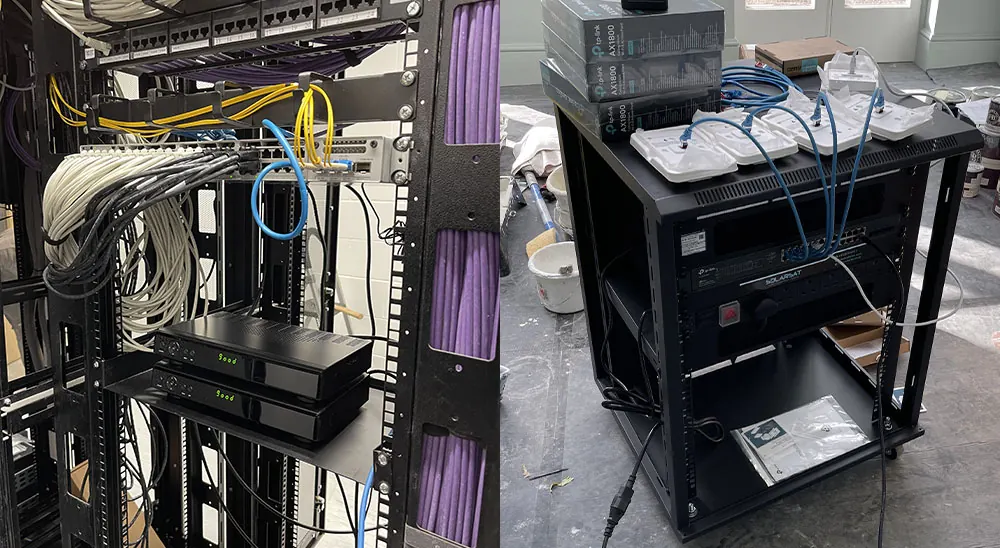
An HDMI extender places a transmitter near the source and a compatible receiver near the display. Some use HDBaseT over suitable twisted-pair cable. Others use different transport systems. The supported picture and audio formats, cable specification, terminations and connection length must all be checked against that exact extender's documentation.
A dedicated extender cable is not automatically an ordinary Ethernet network connection. Many transmitter and receiver pairs connect directly and must not be patched through a network switch. Systems designed for video over IP are different: they use compatible network equipment and may need specific bandwidth, switching and configuration. Similar connectors do not make the technologies interchangeable.
Check whether wall plates, couplers, patch leads or intermediate joints are permitted within the specified route. Data cable that passes a basic continuity test may still be unsuitable for the intended video transport. Follow the required testing and termination method, label dedicated links clearly and retain the equipment details alongside the cable schedule.
Plan replacement access and test real sources
Make concealed routes replaceable wherever practical. Conduit needs enough space for the largest connector, usable bends and accessible entry and exit points. Consider a spare route where later access would otherwise require damaging finished surfaces.
Test the actual source, cable, intermediate equipment and display together before closing walls or ceilings. Select the most demanding intended picture mode and check protected content as well as menus. Run the system long enough to catch intermittent dropouts. Repeat testing after the cable is installed, because routing and handling can introduce damage.
Check sound and control as separate tasks. ARC or eARC needs compatible sockets, devices and a suitable cable path. CEC can carry power, input and volume commands, but device behaviour varies. Confirm return audio, lip sync, standby recovery and normal remote operation. Keep a record of the working input labels and settings for later troubleshooting.
Common HDMI cabling mistakes
One common mistake is approving a route because it displays a static menu, then discovering that a higher-bandwidth game or HDR programme drops out. Another is buying a directional optical lead without checking which end will reach the source. Both problems are easier to catch on the floor than after plastering.
Avoid unnecessary adapters, tightly folded spare cable and inaccessible joins. When faults occur, try a short known-working cable directly between source and display, then add devices back one at a time. Reducing the output format temporarily can help diagnose a bandwidth-related problem, but it does not prove that the installed route meets the original specification.
When to hire a professional installer
Professional help is useful for concealed routes, several connected displays, high-bandwidth gaming setups or persistent faults through receivers and extenders. An installer can separate cable problems from device settings, content protection issues and control conflicts, then recommend a route that remains practical to replace.
Agree the required formats in writing before selecting equipment. Handover should demonstrate each source at its intended settings, including return audio and control where required. Ask for labelled connections and a note of any limitations. Reliable cabling is a tested system with accessible parts, not a claim that one cable will support every future format indefinitely.
Have a question about your own property? Contact our Mildenhall team.
Related services
Services this guide covers

Audio-visual and home cinema
TV wall mounting, media walls, home cinema, multi-room music and commercial AV, designed and installed by our own team.
Find out moreData and network cabling
Wired network sockets, data cabinets and structured cabling for offices and homes, planned for growth and easy to maintain.
Find out more
Media wall installation
AV design, wiring and installation for media walls, planned with your builder or joiner so the screen, sound and equipment fit.
Find out more
FAQs
Frequently asked questions
Want advice for your own home or business?
Call our Mildenhall team or send an enquiry and we will talk through the options.
Enquiries
Ask us a question or get a quote
Tell us a little about your property and what you need. We will get back to you to talk it through.
- 01638 515551
- info@solarsat.co.uk
- Phones and email Monday to Saturday, 8:30am to 6pm
- 8 High Street, Mildenhall, Suffolk IP28 7EQ. Showroom visits by appointment.