
Solarsat guide
Poor TV signal: common causes and how to fix it
A breaking-up picture, stuttering sound or a sudden no-signal message is frustrating, but the cause is usually one of a handful of straightforward faults. Here is how to narrow down the problem safely indoors and when to get an engineer out.
Phones and email Monday to Saturday, 8:30am to 6pm. Showroom visits by appointment.
Start with safe indoor checks
Before assuming the roof aerial or dish has failed, check the simple things inside the room. Inspect the fly-lead running from the wall socket to the back of the television. Cheap moulded white leads break internally when bent sharply behind a cabinet, and loose plugs cause intermittent picture breakup.
If you have more than one television in the house, check whether the problem affects every set or just one. If only one TV has a poor signal, the fault is almost certainly in that room's fly-lead, wall faceplate or the single cable feeding it, rather than the aerial itself.
Check whether you have a loft amplifier or masthead power supply plugged into a mains socket. It is very common for a power unit behind a TV cabinet or in a loft to be switched off accidentally during cleaning or decorating, which immediately kills the signal to every room.
Weather, wind and physical movement
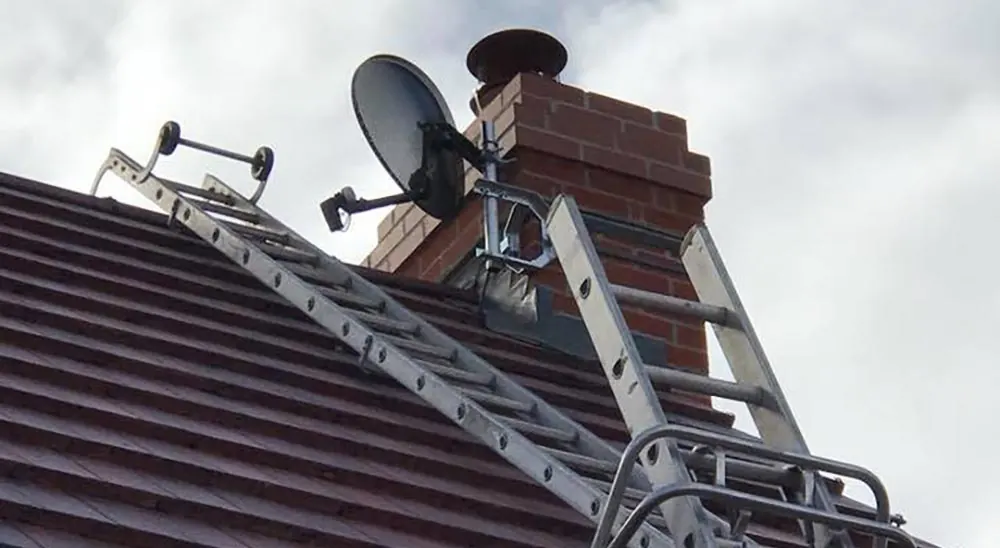
High winds are a frequent cause of sudden signal loss. An ageing bracket or loose U-bolt can let a roof aerial twist a few degrees off the transmitter, or knock a satellite dish out of alignment. Satellite dishes are especially sensitive: even a small shift can wipe out reception completely.
Growing trees are a slower culprit. A signal that worked fine in winter can start breaking up in late spring once leaves fill out directly in the path of the aerial or dish.
Heavy frost and snow can also load up older aerial elements and dish arms, bending thin aluminium brackets that have already been weakened by years of coastal or rural wind exposure.
Water ingress and ageing coaxial cable
Outside coaxial cable takes years of sun, frost and rain. Over time, the outer jacket cracks and rainwater tracks down inside the cable braid. Water ruins the electrical properties of coaxial cable and corrodes connectors, causing gradual loss of channels, especially after wet weather.
If you ever see water dripping from a wall socket or green corrosion on a connector, the cable needs replacing rather than just re-terminating.
Whenever an engineer replaces outdoor coax, they should form a neat drip loop below the entry hole through the brickwork and seal the hole cleanly so rain cannot follow the cable back into your living room.
Splitters, amplifiers and 4G or 5G interference
Adding extra televisions with passive unpowered splitters often drops the signal below the threshold Freeview tuners need. On the other hand, adding a cheap plug-in booster to a noisy signal simply amplifies the noise and can overload the tuner.
Nearby 4G and 5G mobile masts can also interfere with Freeview reception on older aerials that lack built-in filtering. Fitting a dedicated 4G/5G inline filter or upgrading to a filtered aerial usually clears this kind of blocky interference.
What affects repair cost and mistakes to avoid
Repair cost depends on what the meter finds: tightening and realigning an accessible aerial or swapping a corroded connector is a quick visit, whereas replacing perished cabling, a failed masthead amplifier or a rusted chimney bracket takes more time and materials.
Avoid retuning your television repeatedly while the signal is weak. Retuning during a fault wipes out the saved channel list and leaves you with even fewer channels until the underlying reception issue is fixed.
Never climb onto a roof or lean out of an upstairs window to nudge an aerial or dish. Without a meter you are guessing, and the fall risk is not worth it.
When to call an engineer
If indoor fly-leads and power supplies look fine and the problem persists across rooms or after a storm, call an aerial and satellite engineer. Using a calibrated meter, an engineer pinpoints whether the fault is the aerial, dish, LNB, cable, amplifier or local interference in one visit.
Rather than swapping parts at random, meter testing shows exact signal strength, bit error rate and modulation error ratio at the aerial and at each TV point, so the repair fixes the root cause first time.
Have a question about your own property? Contact our Mildenhall team.
Related services
Services this guide covers
TV aerials
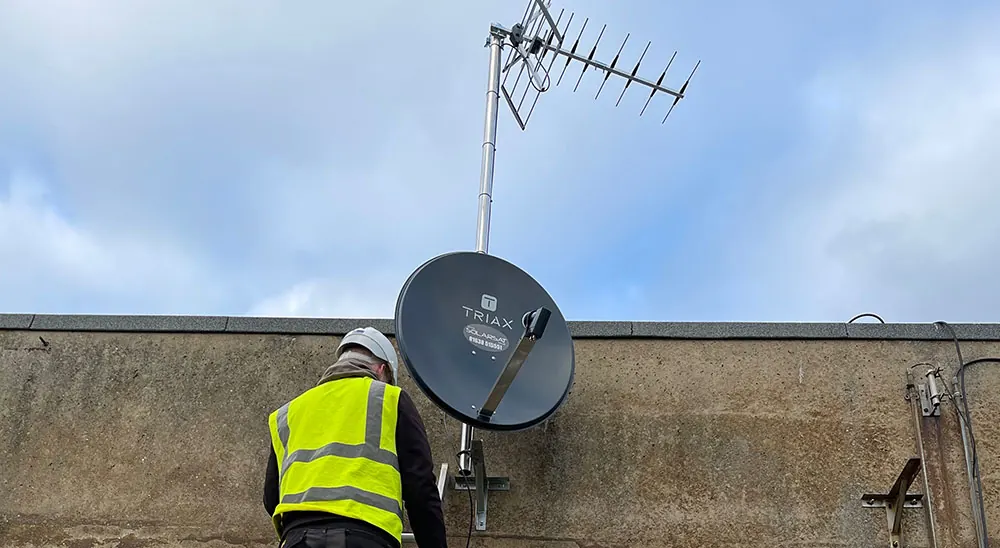
TV aerial installation, extra TV points, multi-point systems for flats and repairs, with over 20 years of experience.
Find out moreSatellite TV
Freesat, Sky and AFN installations, multi-dwelling systems and callout diagnostics for signal problems.
Find out moreFreesat installation
Subscription-free satellite TV dishes, installed and aligned, with feeds to each room and your aerial combined on one plate.
Find out more
FAQs
Frequently asked questions
Want advice for your own home or business?
Call our Mildenhall team or send an enquiry and we will talk through the options.
Enquiries
Ask us a question or get a quote
Tell us a little about your property and what you need. We will get back to you to talk it through.
- 01638 515551
- info@solarsat.co.uk
- Phones and email Monday to Saturday, 8:30am to 6pm
- 8 High Street, Mildenhall, Suffolk IP28 7EQ. Showroom visits by appointment.