
Solarsat guide
Satellite dish installation and realignment: a UK guide
Satellite television relies on a clear line of sight to a fixed point in the southern sky and millimetre-accurate alignment. This guide explains dish placement, mounting choices, storm realignment, cost factors and how to avoid common dish faults.
Phones and email Monday to Saturday, 8:30am to 6pm. Showroom visits by appointment.
Line of sight and where a dish can go
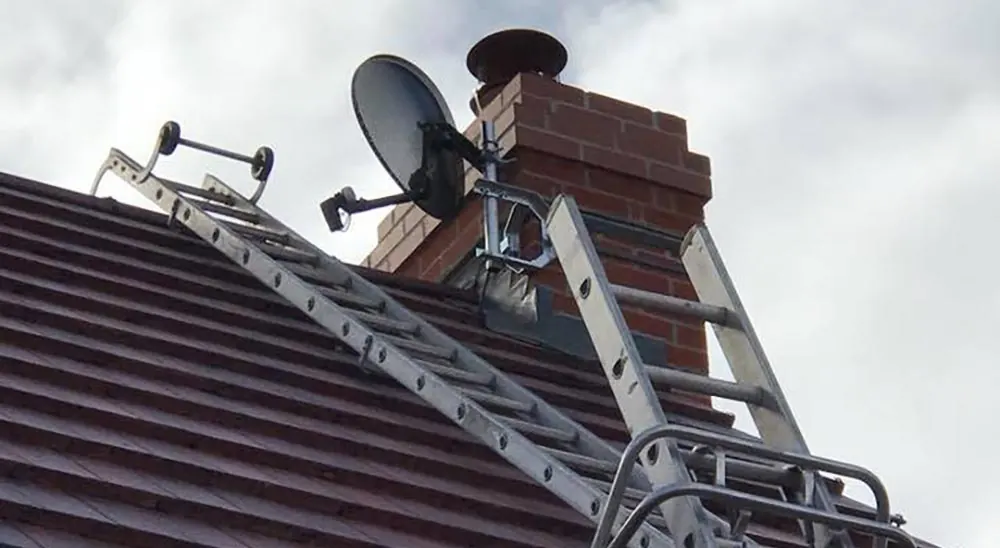
UK satellite services such as Sky and Freesat broadcast from satellites positioned roughly south-east in the sky. A dish does not need to sit on the highest point of the roof; it only needs an unobstructed view of that slice of sky.
Often, a lower brick wall on the back or side of the house is a far better mounting spot than a high chimney. It stays more sheltered from wind, is easier to service later and avoids drilling into old chimney brickwork. Where neighbouring buildings or tall trees block the lower view, a higher gable wall, chimney bracket or pole mount clears the obstacle.
If you live in a listed building, conservation area or rented property, check local planning rules or landlord permission before fitting a dish on a front-facing elevation. Discreet rear or garden pole mounts are often possible when a front wall is restricted.
Understanding the LNB and cabling
The LNB is the small receiver unit at the end of the dish arm. It picks up the reflected signal and sends it down twin or single coaxial cables to your box or television. Different systems need different LNBs: standard quad or octo LNBs feed traditional Freesat and older Sky boxes, while wideband LNBs feed Sky Q and newer Freesat 4K boxes.
Because the LNB sits exposed to rain and frost all year, water getting into poorly sealed F-connectors is one of the most common reasons a dish stops working. Proper self-amalgamating tape or weather boots over every outdoor plug keeps moisture out.
Twin shotgun cable is commonly used for satellite runs because it carries two feeds neatly in one flat profile. Over longer runs, thicker foam-filled copper coaxial cable loses less signal and stands up better to outdoor weathering.
When a dish needs realignment
High winds, heavy snow or a bird landing on a tired arm can nudge a dish off target. Unlike a TV aerial, which may still give a weak picture when slightly twisted, a satellite dish drops from a clear picture to no signal very abruptly.
Realignment is not just about pointing the dish left and right. The installer sets azimuth (horizontal angle), elevation (vertical tilt) and LNB skew (the slight rotation of the LNB) using a satellite spectrum meter to lock onto the exact transponder with maximum signal quality.
What affects installation and realignment cost
Cost depends on whether you need a full new dish and cabling or a realignment of an existing dish, how high the mounting point is, and how many rooms need feeds. Replacing a rusted bracket or perished twin shotgun cable adds materials and labour compared with a simple meter realignment on a reachable wall.
Non-standard setups such as European satellite dishes, AFN satellite dishes or pole-mounted dishes in gardens also require larger brackets and extra alignment time.
Mistakes to avoid
Leaving an old rusted bracket in place and bolting a new dish onto it invites the dish to move again in the next winter gale. Always check that the wall fixings and bracket are solid.
Do not try to align a dish by shouting through a window at someone watching the TV signal bar. TV signal meters lag by several seconds, making accurate alignment almost impossible without a proper meter at the dish.
Avoid running outdoor satellite cable loosely over roof tiles where wind can rub through the outer jacket.
When to hire a professional
Any dish mounted above ground-floor ladder height, any new multi-room cable run or any persistent no-signal fault is a job for a qualified satellite installer. They bring the right LNB, weatherproof connectors, safe access equipment and a meter to confirm full signal margin across every channel.
They can also check whether an existing bracket is still structurally sound before winter winds arrive, and tidy loose outdoor cables clipped to mortar joints so the installation stays neat.
Have a question about your own property? Contact our Mildenhall team.
Related services
Services this guide covers
Satellite TV
Freesat, Sky and AFN installations, multi-dwelling systems and callout diagnostics for signal problems.
Find out moreSky dish installation
New Sky dishes, replacements and realignment, with feeds to extra rooms and fault finding when the picture drops out.
Find out more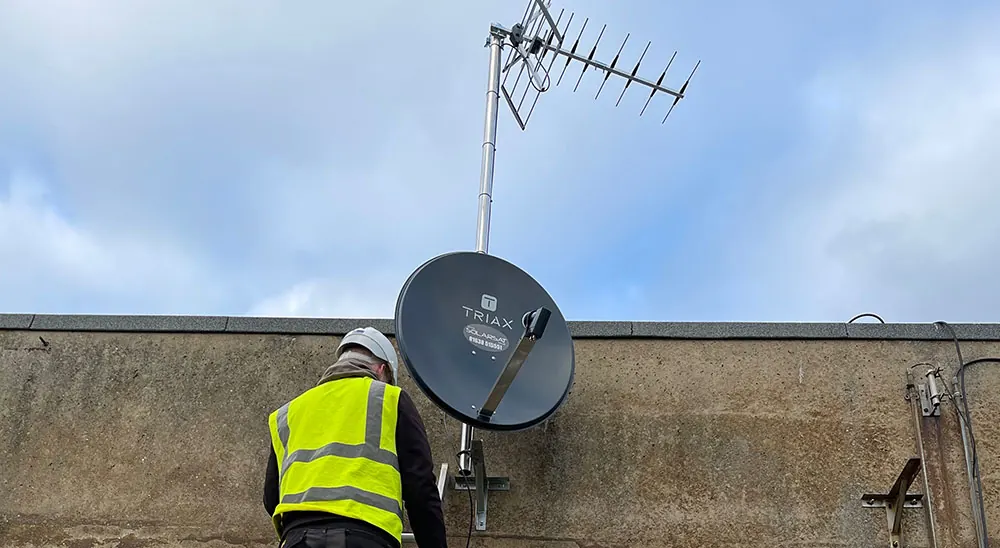
Freesat installation
Subscription-free satellite TV dishes, installed and aligned, with feeds to each room and your aerial combined on one plate.
Find out more
FAQs
Frequently asked questions
Want advice for your own home or business?
Call our Mildenhall team or send an enquiry and we will talk through the options.
Enquiries
Ask us a question or get a quote
Tell us a little about your property and what you need. We will get back to you to talk it through.
- 01638 515551
- info@solarsat.co.uk
- Phones and email Monday to Saturday, 8:30am to 6pm
- 8 High Street, Mildenhall, Suffolk IP28 7EQ. Showroom visits by appointment.