
Solarsat guide
TV aerial and Freeview installation: what to expect
Freeview gives you dozens of live UK channels with no monthly subscription, as long as your aerial receives a clean, steady signal. This guide explains loft versus roof mounting, multi-room feeds, what affects cost and how to avoid common reception problems.
Phones and email Monday to Saturday, 8:30am to 6pm. Showroom visits by appointment.
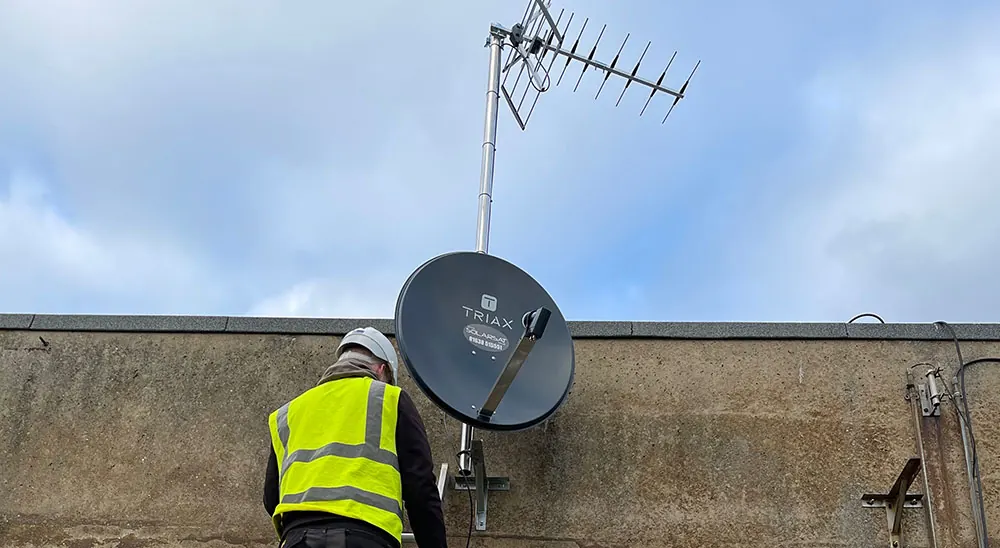
How Freeview reception works in UK homes
Freeview broadcasts over terrestrial radio waves from regional transmitters across the UK. Unlike satellite television, where a dish points high into the sky, a TV aerial points horizontally towards the nearest strong transmitter.
Signal strength varies sharply from one street to the next. Hills, tall trees, metal-clad buildings and thick roof insulation can all weaken or reflect the signal. That is why two neighbouring houses can sometimes need different aerial types or mounting heights.
Different transmitters also use different polarisation, meaning the aerial elements sit horizontally for most main transmitters and vertically for many local relay masts. Fitting the right aerial group and polarisation for your postcode keeps interference low and prevents stronger neighbouring channels from drowning out weaker ones.
Loft aerial versus roof or wall-mounted aerial
Many homeowners ask whether an aerial can go inside the loft to keep the roofline tidy. In strong signal areas, a loft aerial often works well and stays protected from wind, rain and birds.
However, roof tiles, slate and especially foil-backed insulation boards block a large share of the signal. In weaker or fringe areas, a loft aerial may drop channels in poor weather or miss high-definition multiplexes altogether. Mounting the aerial outdoors on a gable wall or chimney gives a much stronger, cleaner signal.
An installer checks the signal with a spectrum meter before fixing the bracket permanently, so you know whether a loft install will hold up year-round or whether an outside position is needed.
Multi-room TV points and distribution
If you want Freeview in bedrooms, a kitchen or a garden room as well as the lounge, the signal needs to be split properly. Passive Y-splitters cut the signal strength in half each time you split it, which often tips borderline rooms into pixelation.
A powered distribution amplifier mounted in the loft takes one strong feed from the aerial and sends a balanced signal down dedicated coaxial cables to each TV wall plate. Using quality double-screened copper coaxial cable prevents interference from nearby electrical wiring and mobile masts.
What affects the cost of a TV aerial installation
The price of a new aerial install depends on access height, the strength of the local signal and how many rooms you want connected. A straightforward single-room install on an accessible gable wall takes far less time than a chimney-mounted high-gain aerial feeding four bedrooms.
Other factors include whether existing cabling is reusable or perished, whether a masthead amplifier or 4G/5G filter is needed, and whether roof access requires specialist ladders or safety equipment.
If you are renovating or extending, mentioning how many bedrooms, kitchens or garden rooms may need a TV point later allows the installer to size the distribution amplifier once, rather than coming back to upgrade it a year down the line.
Mistakes to avoid
Buying a cheap indoor set-top aerial rarely works reliably unless you live very close to a main transmitter. Indoor aerials pick up electrical noise from appliances and drop out whenever someone walks past.
Reusing twenty-year-old brown coaxial cable with cracked outer sheathing is another false economy. Water creeps down old cable, corrodes the copper core and ruins the signal even when a brand-new aerial is fitted at the top.
Pointing an aerial by eye at the same angle as a neighbour's does not guarantee good reception. A few degrees off alignment, or the wrong polarisation, can lose whole groups of channels.
When to hire a professional aerial installer
Working at roof height on ladders carries real safety risks, and without a digital signal meter it is hard to tell whether a signal has enough margin to survive heavy rain. A professional installer measures signal quality as well as strength, fits weatherproofed connections and leaves every room tuned and tested.
A good installer will also check whether your existing wall plates, coax leads and splitters are holding back the signal, so you do not pay for a new roof aerial when the real bottleneck is inside the loft or behind the living-room cabinet.
Have a question about your own property? Contact our Mildenhall team.
Related services
Services this guide covers
TV aerials
TV aerial installation, extra TV points, multi-point systems for flats and repairs, with over 20 years of experience.
Find out moreFreesat installation
Subscription-free satellite TV dishes, installed and aligned, with feeds to each room and your aerial combined on one plate.
Find out more
Satellite TV
Freesat, Sky and AFN installations, multi-dwelling systems and callout diagnostics for signal problems.
Find out more
FAQs
Frequently asked questions
Want advice for your own home or business?
Call our Mildenhall team or send an enquiry and we will talk through the options.
Enquiries
Ask us a question or get a quote
Tell us a little about your property and what you need. We will get back to you to talk it through.
- 01638 515551
- info@solarsat.co.uk
- Phones and email Monday to Saturday, 8:30am to 6pm
- 8 High Street, Mildenhall, Suffolk IP28 7EQ. Showroom visits by appointment.